Neogogy Human Advantage Assessment
AI is becoming more capable.
Are you?
The Neogogy Human Advantage Assessment examines whether the way you use AI, or choose not to use AI, is building the capabilities your future requires.
Is the way you use AI, or choose not to use AI, strengthening your capabilities?
- About 10 to 12 minutes
- 7 perspectives
- Research informed
- A personal Human Advantage Report to keep
Powered by ICAN.ph
Ten stages, from first contact to a practice that renews itself. Your answers place you on this route.
Choose your assessment
Choose the part of your life you want to examine.
Your Human Advantage looks different depending on the work you do and the responsibilities you carry. The assessment asks different questions for different contexts. Choose the perspective that best matches what you want to examine.






 EmergenceStudent
Emergence
Student
You are studying, at any level.
- High school
- College
- University
- Graduate education
- Professional learning
- Adult education
Is the way you use AI, or choose not to use it, strengthening your ability to learn?
What this assessment is about
These questions are about your own learning and your own work. They do not primarily ask what you know about artificial intelligence.
They ask what you actually do with AI when you write, research, revise, solve problems, complete assignments, prepare for exams, collaborate, and perform work where AI is unavailable.
The assessment examines whether AI assisted work becomes knowledge and capability that are genuinely yours. It also looks for situations where excellent AI assisted output may be hiding work you could not yet reproduce independently.
And it examines underexposure. If you use little AI, it considers whether limited experience is leaving important AI fluency, adaptability, judgment, or future readiness undeveloped.
Why this matters
A completed assignment can look excellent while telling us very little about what the student actually learned.
Your Human Advantage includes being able to explain it, remember it, question it, reproduce important work, perform without AI when necessary, and use AI intelligently when it helps.
You will be asked about
- Essays, assignments and revisionHow AI enters the actual work you submit and what parts of the thinking remain yours.
- Exams and unaided workWhat happens when you must perform without AI.
- Understanding and retentionWhether AI assisted work becomes knowledge you can use later.
- Research and verificationHow you decide whether information from AI deserves trust.
- Group work and authorshipHow AI generated contributions are handled when other people are involved.
- AI fluency and future readinessWhether you are developing the ability to work intelligently with AI rather than merely avoiding it or depending on it.
What you may discover
- Where AI appears to strengthen your learning
- Where it may be replacing learning
- How much capability remains without assistance
- Whether practical AI fluency is developing
- How judgment and verification are functioning
- What your next developmental stage requires
About 10 minutes
Your answers generate a personal Human Advantage Report, with your position, your pattern, what to watch, and what to do next.
EmergenceStudentEmergence
Student
You are studying, at any level.
- High school
- College
- University
- Graduate education
- Professional learning
- Adult education
Is the way you use AI, or choose not to use it, strengthening your ability to learn?
What this assessment is about
These questions are about your own learning and your own work. They do not primarily ask what you know about artificial intelligence.
They ask what you actually do with AI when you write, research, revise, solve problems, complete assignments, prepare for exams, collaborate, and perform work where AI is unavailable.
The assessment examines whether AI assisted work becomes knowledge and capability that are genuinely yours. It also looks for situations where excellent AI assisted output may be hiding work you could not yet reproduce independently.
And it examines underexposure. If you use little AI, it considers whether limited experience is leaving important AI fluency, adaptability, judgment, or future readiness undeveloped.
Why this matters
A completed assignment can look excellent while telling us very little about what the student actually learned.
Your Human Advantage includes being able to explain it, remember it, question it, reproduce important work, perform without AI when necessary, and use AI intelligently when it helps.
You will be asked about
- Essays, assignments and revisionHow AI enters the actual work you submit and what parts of the thinking remain yours.
- Exams and unaided workWhat happens when you must perform without AI.
- Understanding and retentionWhether AI assisted work becomes knowledge you can use later.
- Research and verificationHow you decide whether information from AI deserves trust.
- Group work and authorshipHow AI generated contributions are handled when other people are involved.
- AI fluency and future readinessWhether you are developing the ability to work intelligently with AI rather than merely avoiding it or depending on it.
What you may discover
- Where AI appears to strengthen your learning
- Where it may be replacing learning
- How much capability remains without assistance
- Whether practical AI fluency is developing
- How judgment and verification are functioning
- What your next developmental stage requires
About 10 minutes
Your answers generate a personal Human Advantage Report, with your position, your pattern, what to watch, and what to do next.
Human Advantage
What is your Human Advantage?
As AI becomes more capable, the important question is not whether humans can outperform machines at every task. The question is whether people are developing the judgment, independence, creativity, adaptability, responsibility, and wisdom required to use powerful systems without surrendering the capabilities that should remain theirs.
Your Human Advantage is not simply what AI cannot do. It is the capability you continue to build, own, exercise, and take responsibility for in a world where AI is everywhere.
The ten dimensions your answers are read across. They move independently, and the shape you make across all ten is the finding.
The goal is not more AI.
The goal is not less AI.
The goal is greater Human Advantage.
Use AI without preserving independent capability and dependence can grow. Avoid AI completely and important fluency, adaptability, and judgment may remain underdeveloped.
The challenge is learning to use AI in ways that make the human stronger.
Two risks, not one
Both ends of the range carry a cost.
Too dependent
- Independent capability becomes less practiced
- Verification decreases
- Judgment shifts toward the tool
- Authorship becomes less clear
- Knowledge does not transfer
- Important work becomes difficult without AI
Too disconnected
- AI fluency remains weak
- Adaptability develops slowly
- AI judgment stays theoretical
- Emerging workflows remain unfamiliar
- Opportunities for legitimate augmentation are missed
- Future readiness suffers
Capable and intentional
Use AI where it strengthens you. Preserve what should remain yours. Build the judgment to know the difference.
This is not a middle setting on a dial. A person may use AI heavily for one task and not at all for another. Human Advantage concerns intentionality, capability, judgment, and ownership.
Capable humans know when to use AI, how to use it, and when not to use it.
Output is not capability
Better AI assisted performance does not automatically mean greater human capability.
- A better essaydeeper learning
- A faster decisionbetter judgment
- A polished sermondeeper study
- A more efficient workflowa more resilient business
The Human Advantage Assessment looks beneath the output.
Easy to see
- Speed
- Polished output
- More content
- Better formatting
- Instant information
- Automated tasks
Harder to see
- Judgment
- Memory
- Independent capability
- Verification
- Authorship
- Depth
- Transfer
- Agency
- Adaptability
Productivity shows what was produced. Human Advantage asks what capability was developed.
If AI disappeared tomorrow, what could you still do?
- Explain the thinking?
- Reproduce the work?
- Make the decision?
- Teach the idea?
- Defend the conclusion?
- Remember what you learned?
- Perform the task?
- Recognize when something is wrong?
Independence matters. But this is only half of the question.
If AI becomes dramatically more capable tomorrow, will you know how to work with it?
- Understand what it does well?
- Identify where it should not be trusted?
- Verify its output?
- Collaborate intelligently?
- Redesign workflows?
- Remain responsible for decisions?
- Know what should stay human?
- Adapt as technology changes?
Fluency matters too, and it is not the same thing as exposure.
Human Advantage requires both. The capability to work independently when necessary, and the capability to work intelligently with AI when it helps.
Research informed
The same technology can produce very different human outcomes.
- 95%of students now use AI, and 94 percent use it on work that is assessed, while fewer than half say their teaching staff are helping them build the skill.HEPI / Kortext 2026
- 17%worse on a later unaided exam for those who practised with an unrestricted chatbot, against no AI at all.Bastani et al., PNAS 2025
- 2xthe learning gains when the same technology is used deliberately, against established classroom practice.Kestin et al., Scientific Reports 2025
Same technology. Different human outcomes. How we use AI matters.
What makes it different
What makes the Neogogy Human Advantage Assessment different?
It measures the human side of AI
Most AI assessments ask what you know about AI. This one examines what your relationship with AI appears to be doing to your capabilities.
It looks at both dependence and underexposure
More AI is not automatically better. Less AI is not automatically healthier.
It separates output from capability
Excellent assisted work does not guarantee excellent independent capability.
It examines independence and augmentation
Can you work without AI? Can you work better with AI? Both matter.
It is context specific
A student’s relationship with AI is fundamentally different from a teacher’s, parent’s, leader’s, minister’s, or business owner’s. The assessment changes accordingly.
It gives you somewhere to go
You do not finish with a label. You receive a developmental position and practices for moving forward.
Your Human Advantage Report
This is not just a score. It is a map of where you are and what to strengthen next.
Your answers produce a personal reading: your position on the continuum, the pattern behind it, and the one capability doing most to hold you where you are. The developmental visualisation inside it is your Capability Map.
- 01Your positionSee where your current practices place you on a developmental continuum.
- 02Your patternUnderstand what your answers suggest about your current relationship with AI.
- 03Your strengthsSee which capabilities appear to be holding strong.
- 04What to watchIdentify dependence, underexposure, verification, transfer, or judgment areas that need attention.
- 05Your constraintSee which capability is currently doing the most to limit movement toward the next stage.
- 06Your next stageUnderstand what development looks like from here.
- 07What to do nextReceive practical actions and habits for continued development.
Inside the report
Real pages, rendered by the same engine that will read your answers. The numbers on them belong to one example profile rather than to you. Open any page to read it.
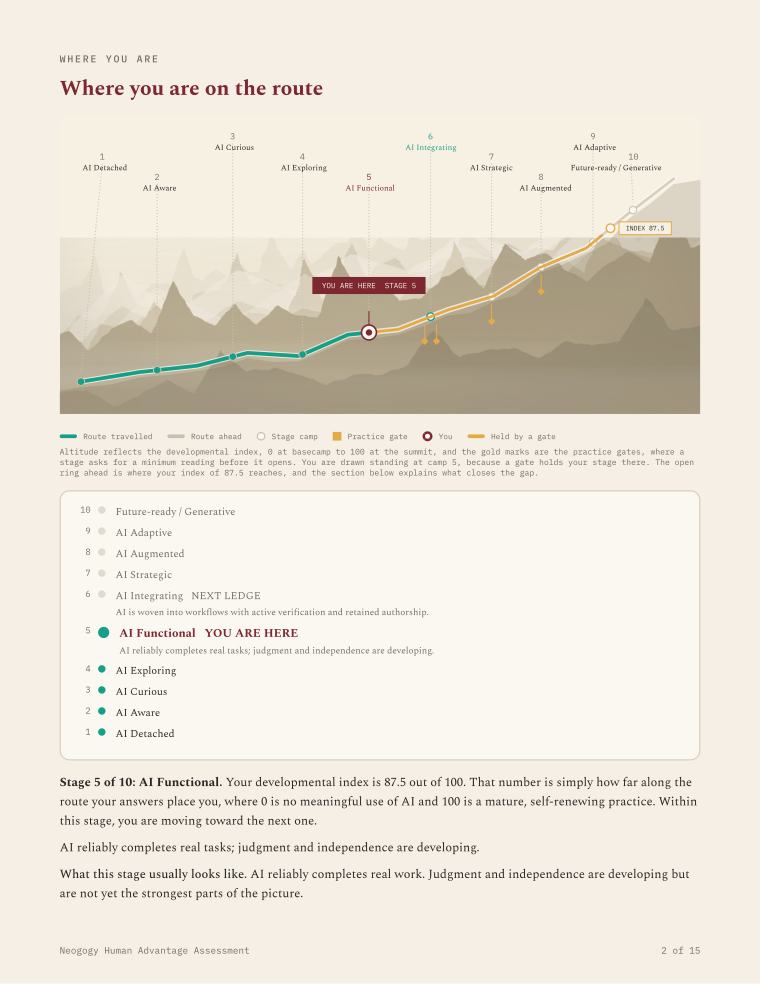 Where you are on the route
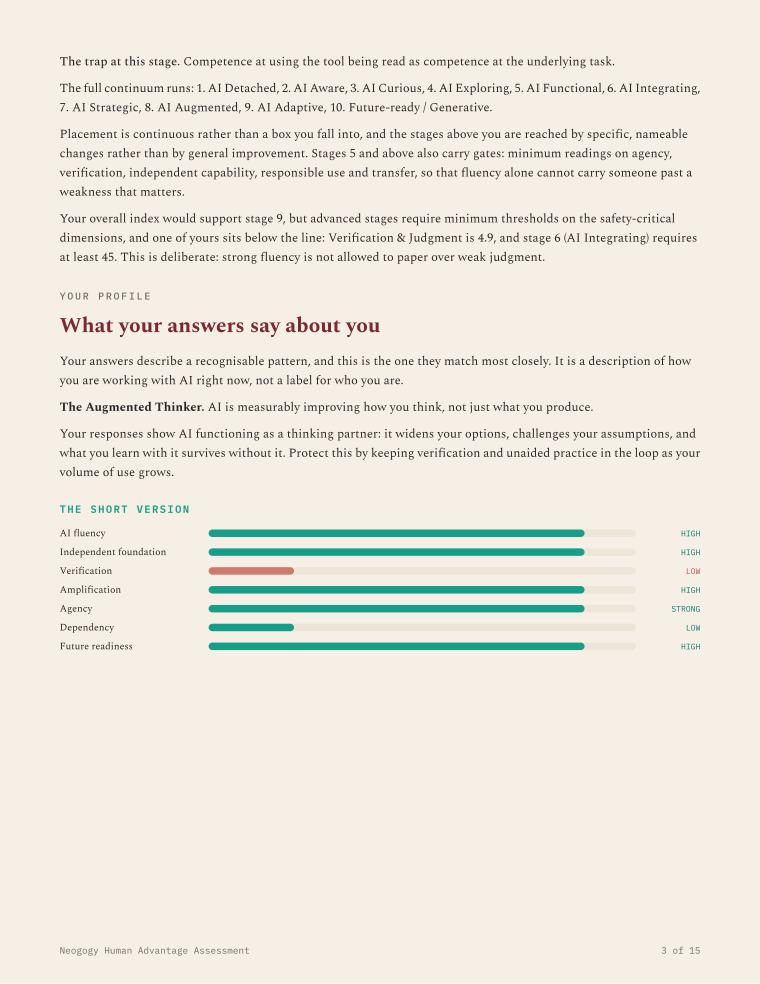 What your answers say about you
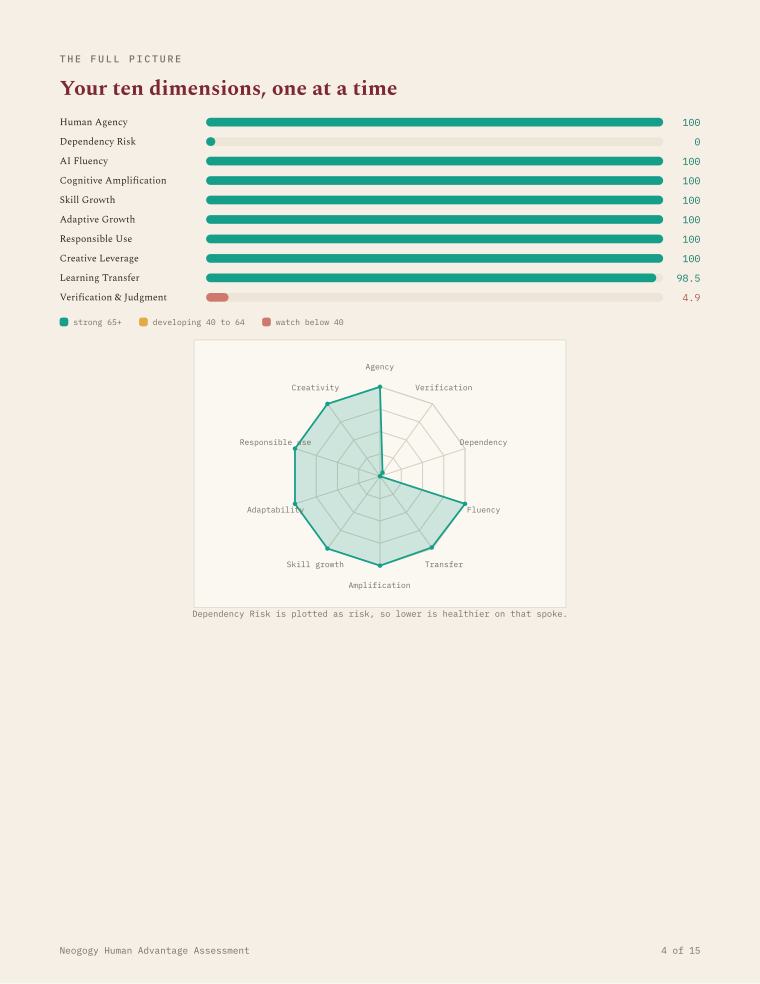 Ten dimensions, one at a time
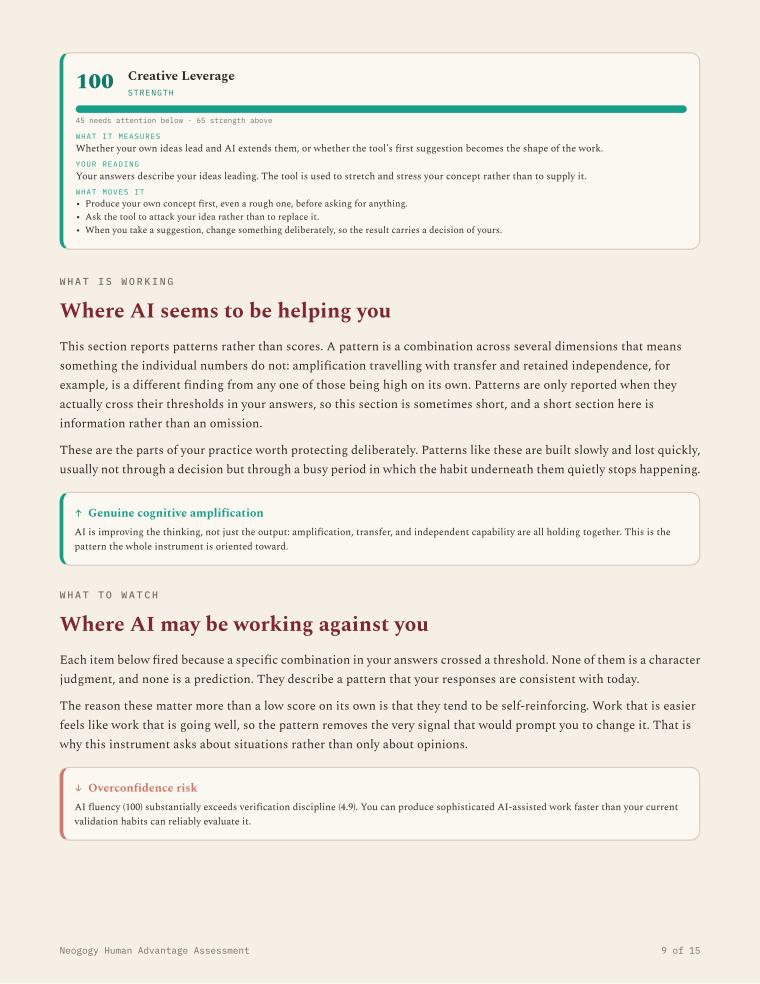 What is helping, and what is working against you
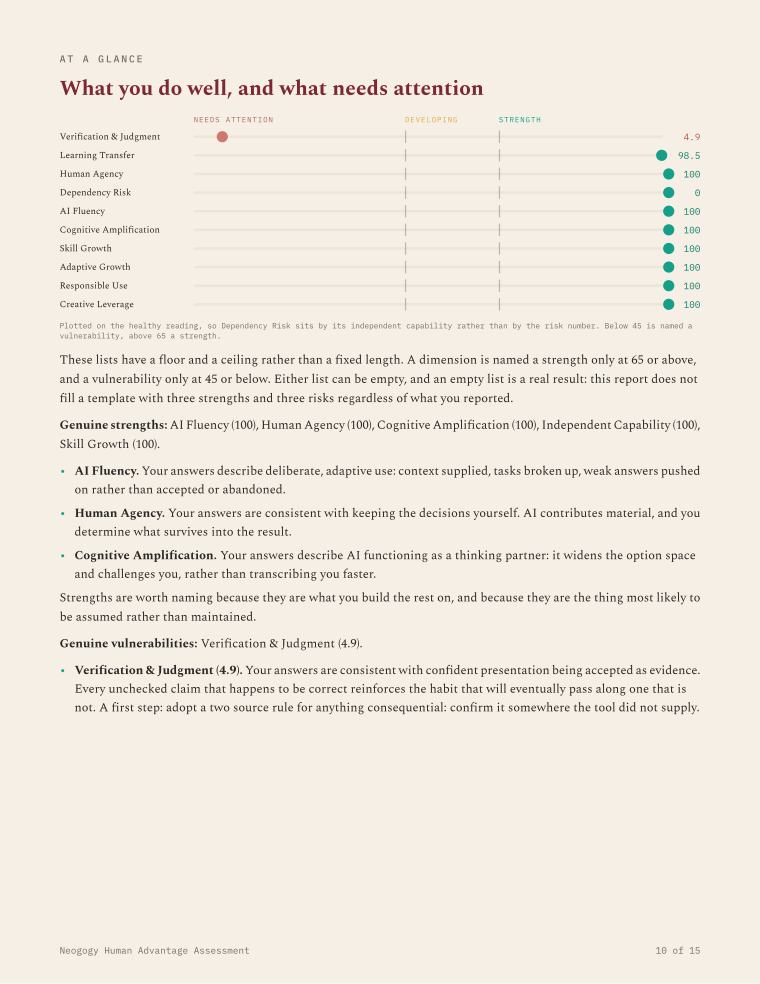 What you do well, and what needs attention
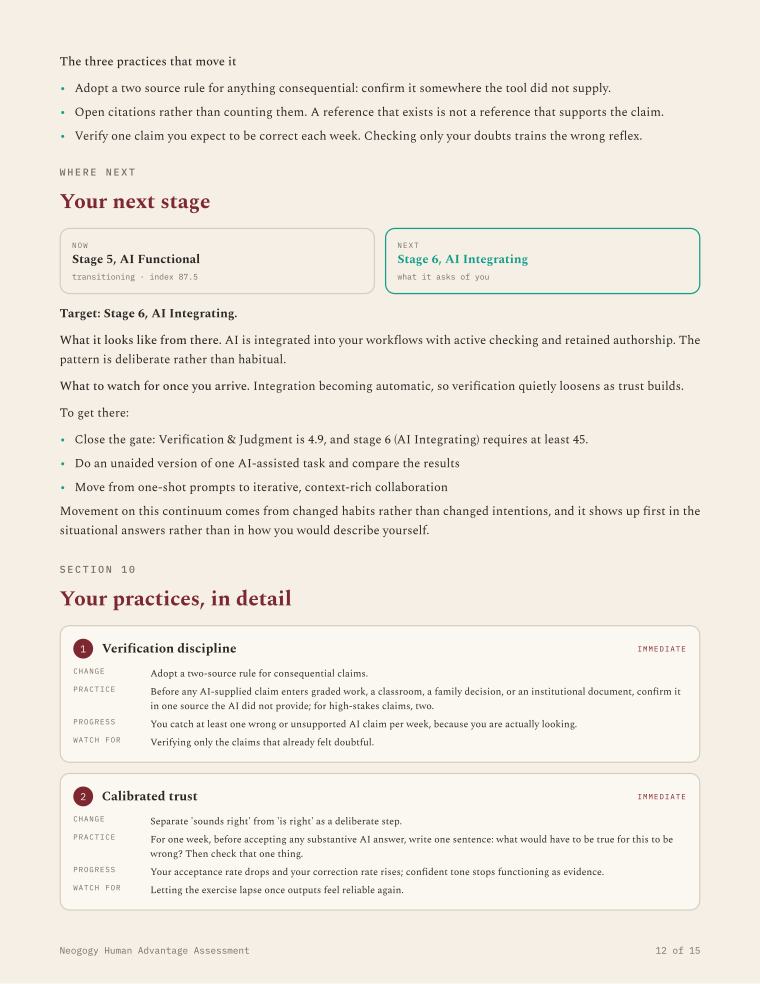 Your next stage, and the practices that reach it
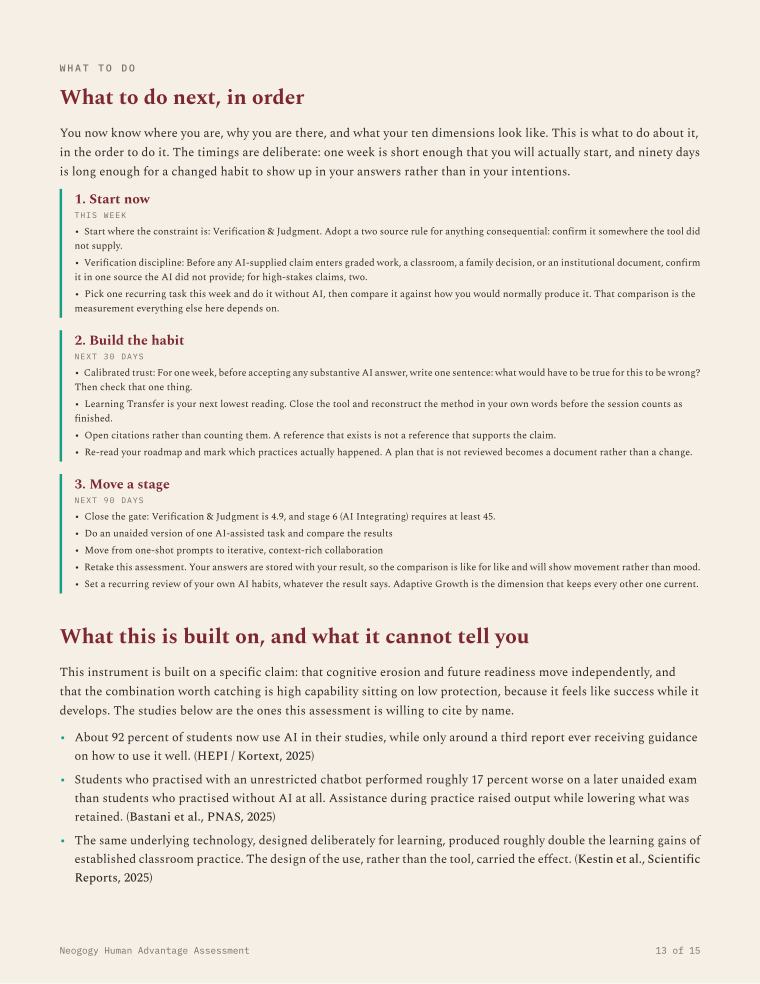 What to do next, in order
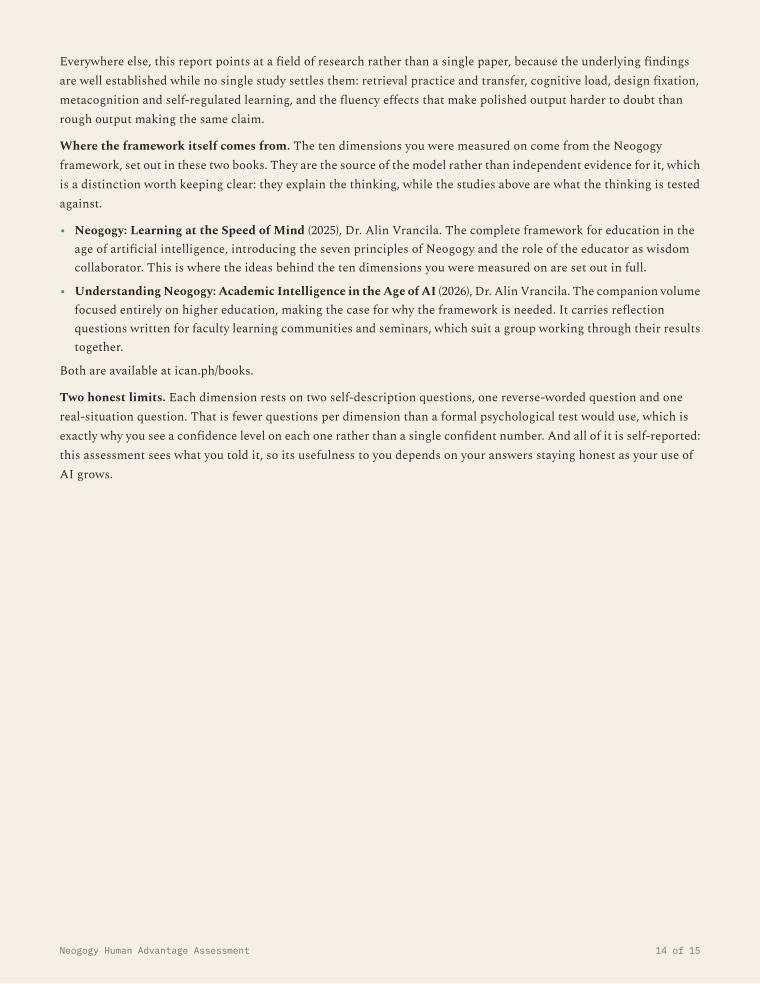 What this is built on, and what it cannot tell you
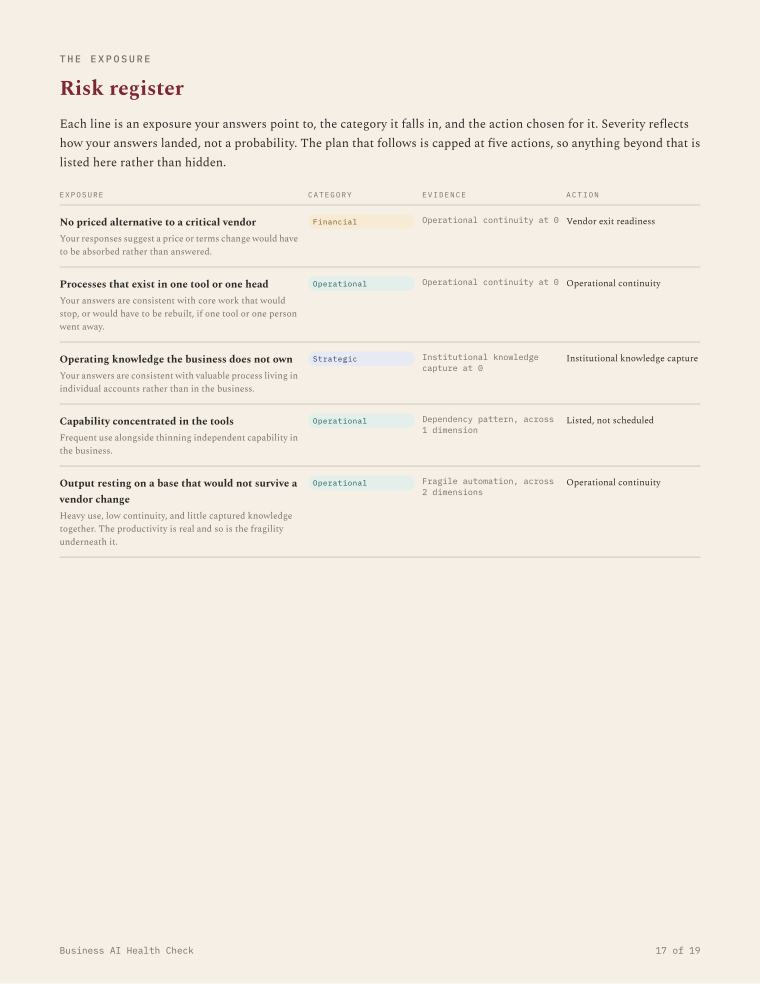 Business OwnerA risk register
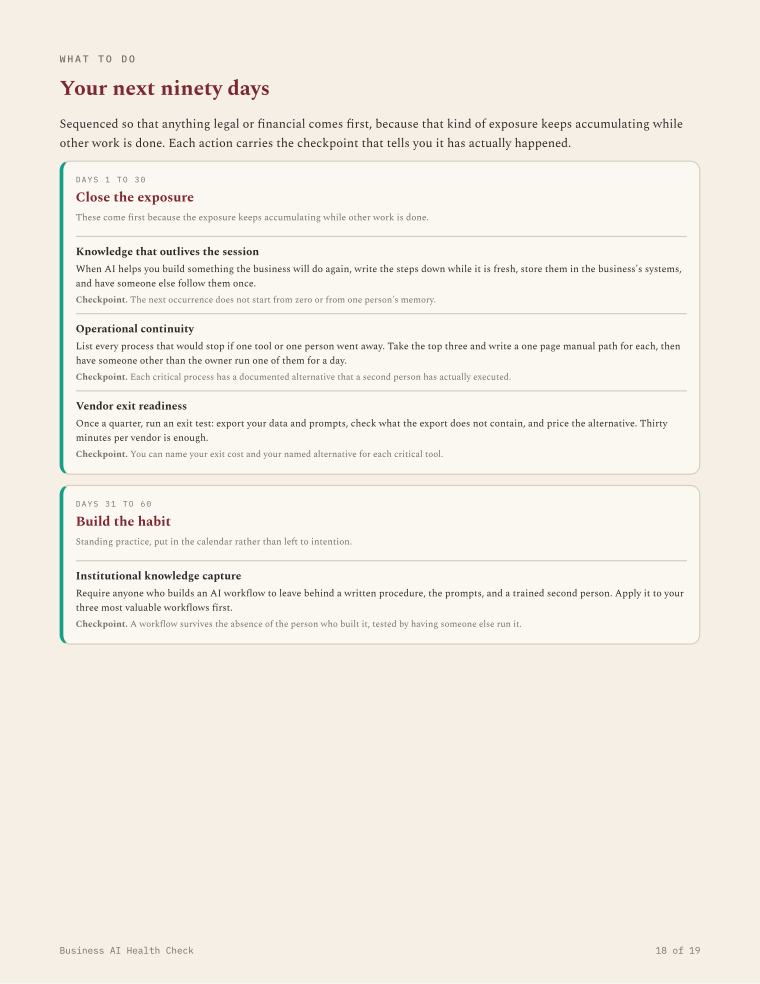 Business OwnerYour next ninety days
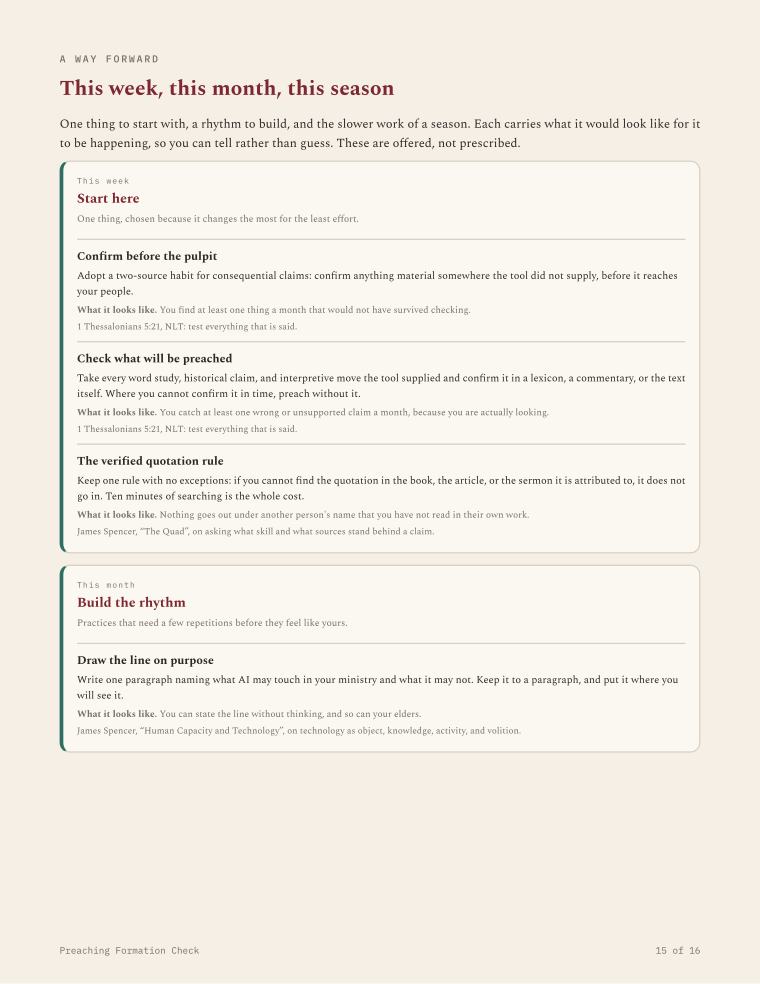 MinisterThis week, this month, this season
The work behind the assessment
Built and maintained across four organisations

Your Human Advantage can change.
AI changes. Your responsibilities change. Your habits change. Your capabilities change.
These are assessment indices built from self reported answers. They are designed to support reflection, and they are not a clinical diagnosis, a psychological evaluation, or a validated psychometric measurement.
Neogogy Human Advantage Assessment. Powered by ICAN.ph